Pranyx.ai

AI for regulated workflows

Pranyx.ai

AI needs more than instructions.
It needs boundaries.

AI systems are probabilistic. Regulated workflows need defined rules. Explore our clinical AI workflows and see how Pranyx independently evaluates proposed actions against a formal Patient Intake policy.

Two capabilities. One direction.

Useful AI.
Defined boundaries.

01

Clinical AI Workflows

Patient-facing scheduling, application-controlled booking and cancellation, PII-redaction workflows, and FHIR R4 appointment export. A working healthcare demonstration with operational views for administrators.

Explore the scheduling use case →
02

Compliance Studio

A separate Patient Intake demonstration: a workflow proposes an action, Pranyx checks the formal policy, and a deterministic decision explains why it is allowed or blocked. The decision does not rely on an LLM.

Explore Compliance Studio →

Clinical AI Workflows

From conversation
to appointment.

See patient registration checks, doctor availability and appointment booking in the existing scheduling demo.

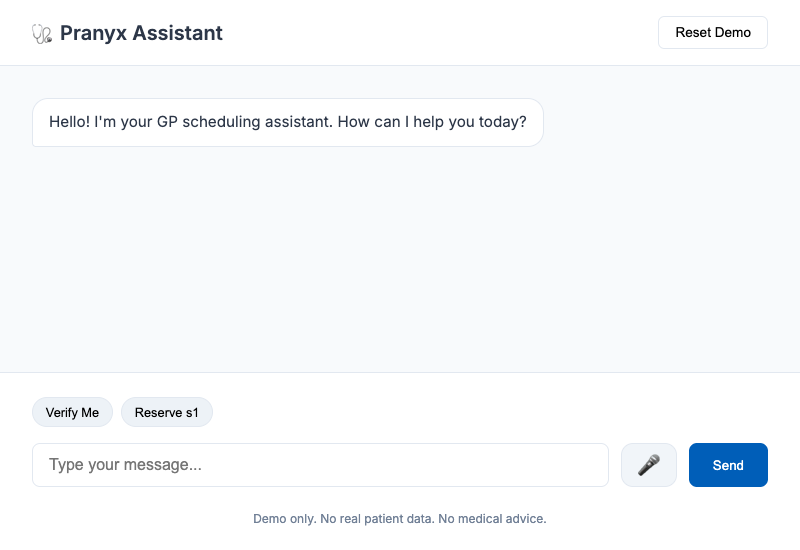
Pranyx scheduling assistant greeting a patient, with message and voice controls. Open the protected Clinical AI Demo.
The current scheduling interface. Use synthetic information when trying the demo.

Clear about what exists

Demonstration today.
A platform direction.

Privacy-conscious design, not a zero-disclosure guarantee

The clinical demo replaces detected PII before the scheduling-model request. Its detection step currently also uses an external model, so it does not guarantee that patient data stays local.

Inspectable decisions, not regulatory certification

Admin exposes clinical workflow events. Compliance Studio exposes formal evidence and a session-only decision log. Neither is a claim of certified compliance or a tamper-evident production audit system.

Complementary capabilities, not yet an integrated gateway

Connecting clinical AI actions to formal enforcement is our intended direction. Today's scheduling and compliance demonstrations are separate; automatic enforcement for arbitrary SOPs is not yet available.